Building self-service CX blueprint for Dan Murphy's Cancel & Refund
Turning a broken post-purchase experience into a prioritised self-service roadmap.
The project
Client: Dan Murphy's
Industry: Retail, Ecommerce
Timeline: 3 months (2021)
My Role: UX lead
Dan Murphy's ecommerce operation was growing fast, but the post-purchase experience hadn't kept pace. Cancellations, refunds, and returns were handled entirely through assisted channels, with no self-service, no documented processes, and no shared view of what was going wrong.
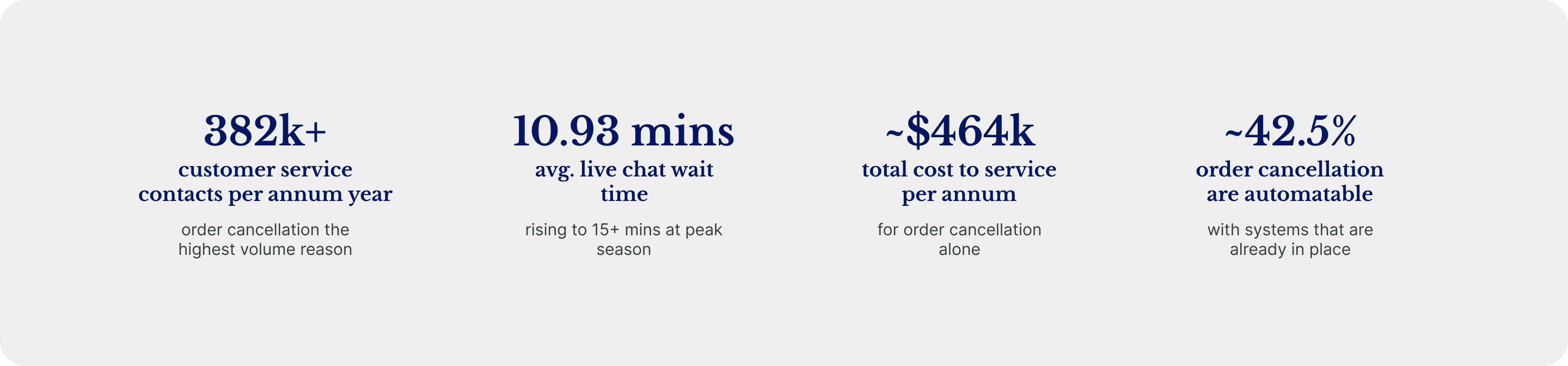
The business could feel the cost. What it couldn't do was act with confidence. Without evidence, every proposed fix was a guess.
The plan & objectives
The instinct is always to jump to solutions. Instead, we chose to document the full as-is first. Not as a process exercise, but as a way to build a shared, evidence-backed view of the problem that could drive real investment decisions.
The risk of skipping this step: spending on the wrong solutions. The payoff: a roadmap the business could actually commit to.
Working with a Business Analyst and Data Analyst from the Customer Service team, we set four objectives:
Map every cancellation, return and refund journey end-to-end across all order types
Identify what was failing customers, agents, and the business
Quantify the problem with data so opportunities could be compared and prioritised
Build a roadmap that connected pain to priority to action
The work: map before we build
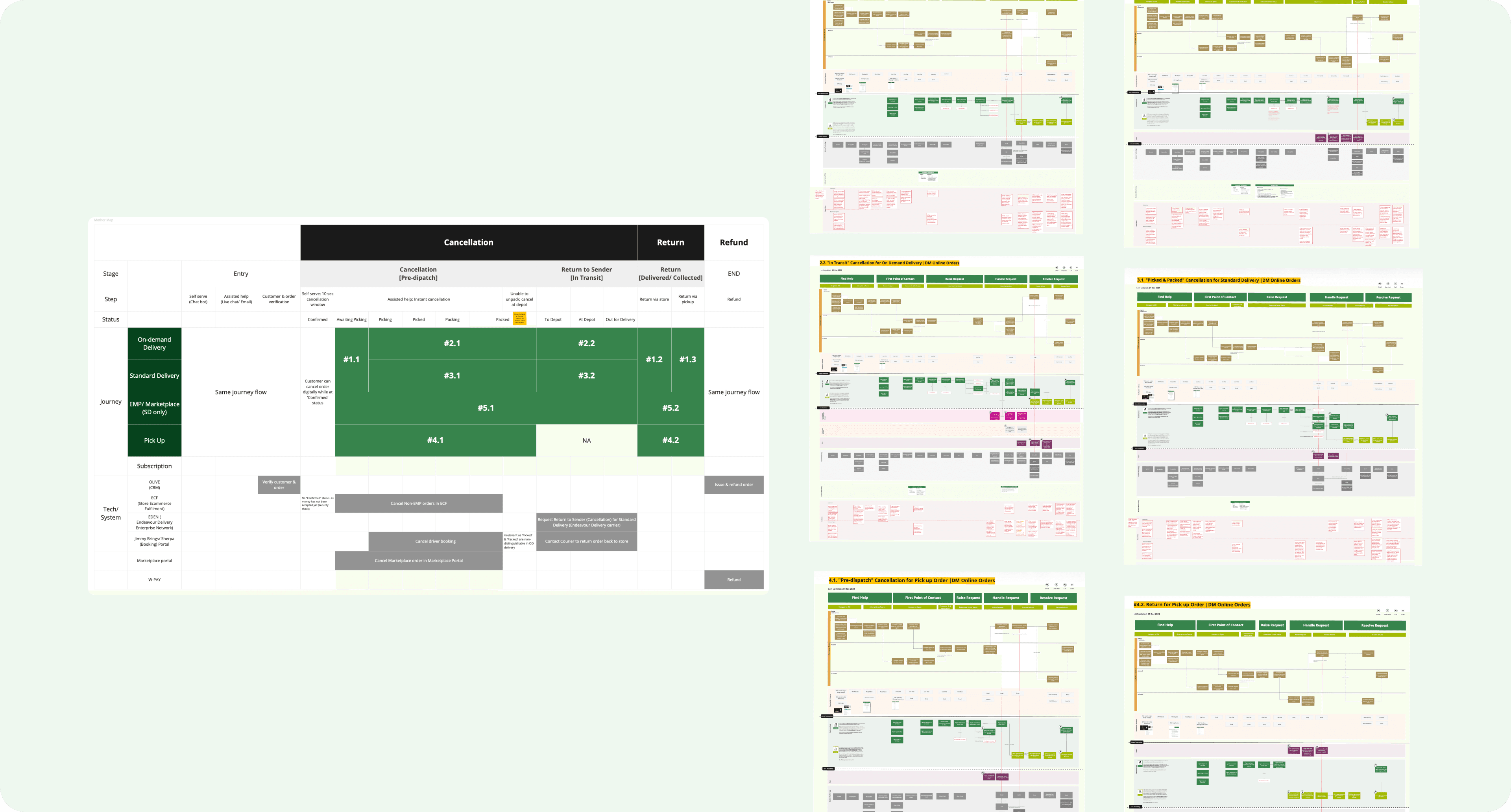
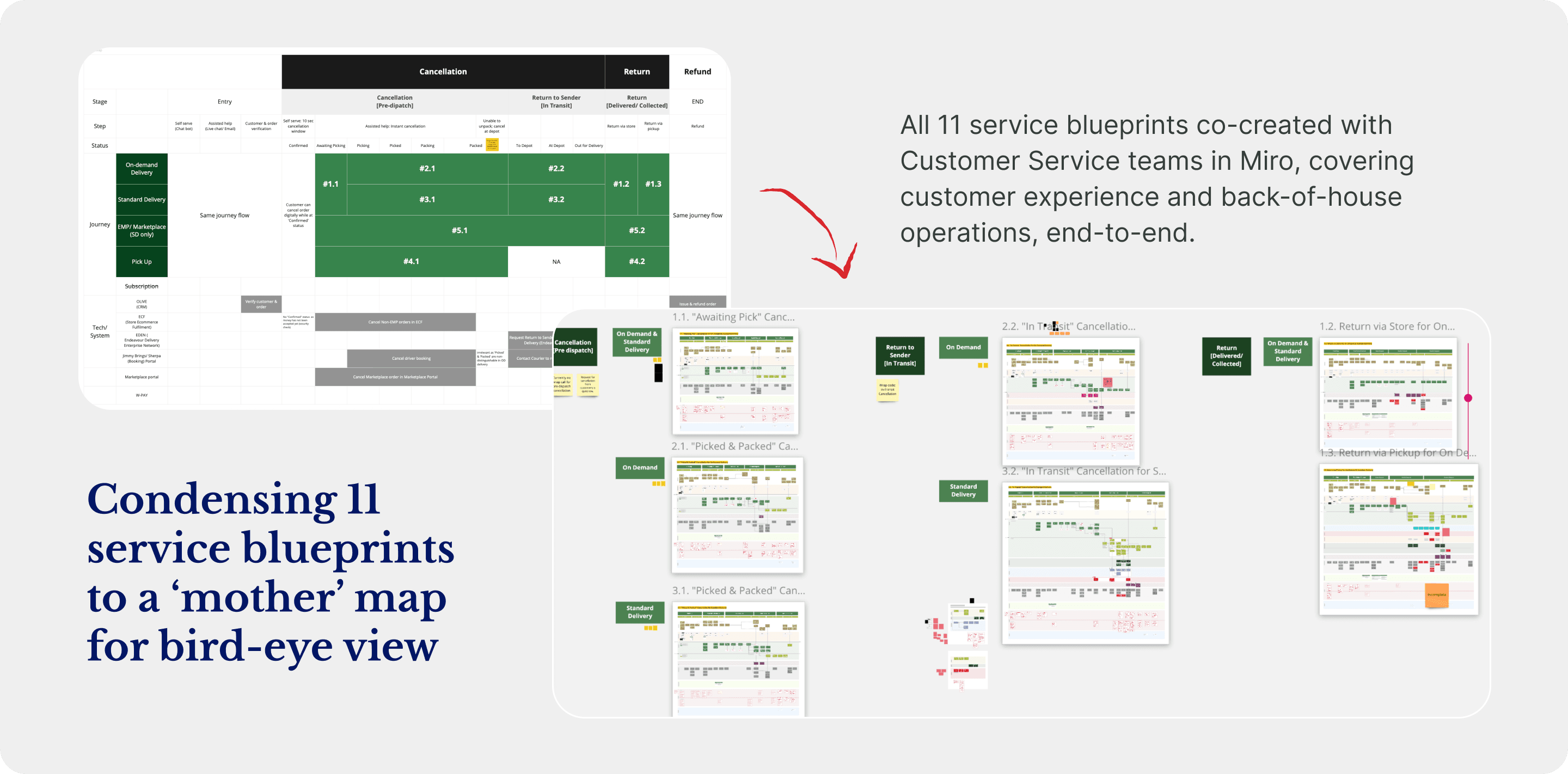
We mapped 11 distinct journeys spanning on-demand delivery, standard delivery, Marketplace orders, and pick-up, spanning every order state from a product sitting in the warehouse to one already on a courier truck. Each scenario was complex enough to need its own blueprint.
For every journey: how customers find help, how they raise a request, how agents verify and action it, which systems are involved, and where the handoffs break down. The blueprints became the first-ever documented record of how this process actually worked.
We also mapped the tech ecosystem: six platforms, largely operating in isolation. Agents routinely moved between four or more systems to resolve a single request, manually bridging gaps that should never have existed.
Key findings that shape everything
Discovery 1: The absence of self-service was structural, not incidental.
Not one of the 11 journeys had a digital self-serve option. Every customer had to contact the team to cancel or return, regardless of how simple the request. This wasn't a missing feature. It was a fundamental design gap baked into every order type and every scenario.
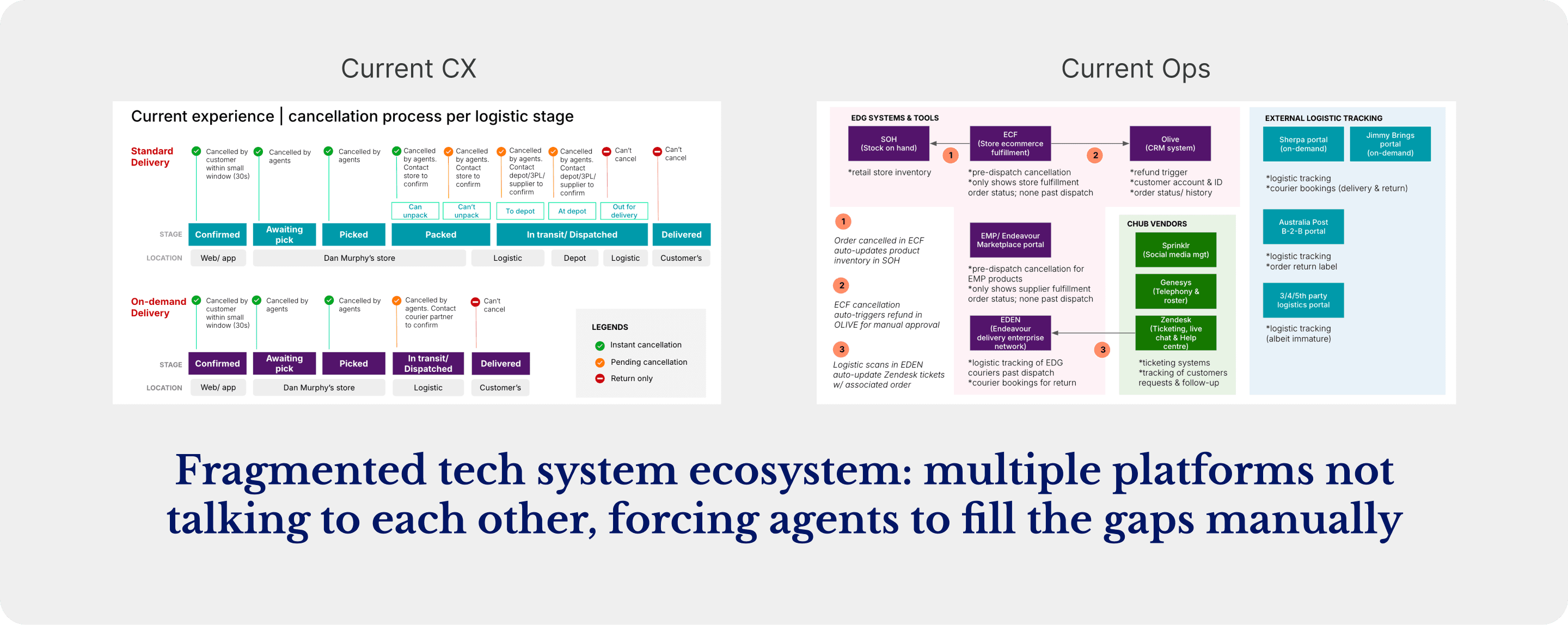
Discovery 2: The systems weren't built to work together.
Agents had no single view of an order. They switched between platforms, made judgment calls on refunds without visibility of return status, and waited on third-party confirmations before they could act. Every manual step added handling time and introduced risk. The fragmentation was a cost multiplier at every stage.
Discovery 3: The biggest opportunity was already within reach.
42.5% of all cancellations were pre-dispatch orders, the simplest scenario to resolve. This equates to ~$194k in saving per annum. The systems needed for automation were already in place. This was not a future-state aspiration; it was a near-term opportunity hiding in plain sight, with high customer value and low technical complexity.
From insights to actions
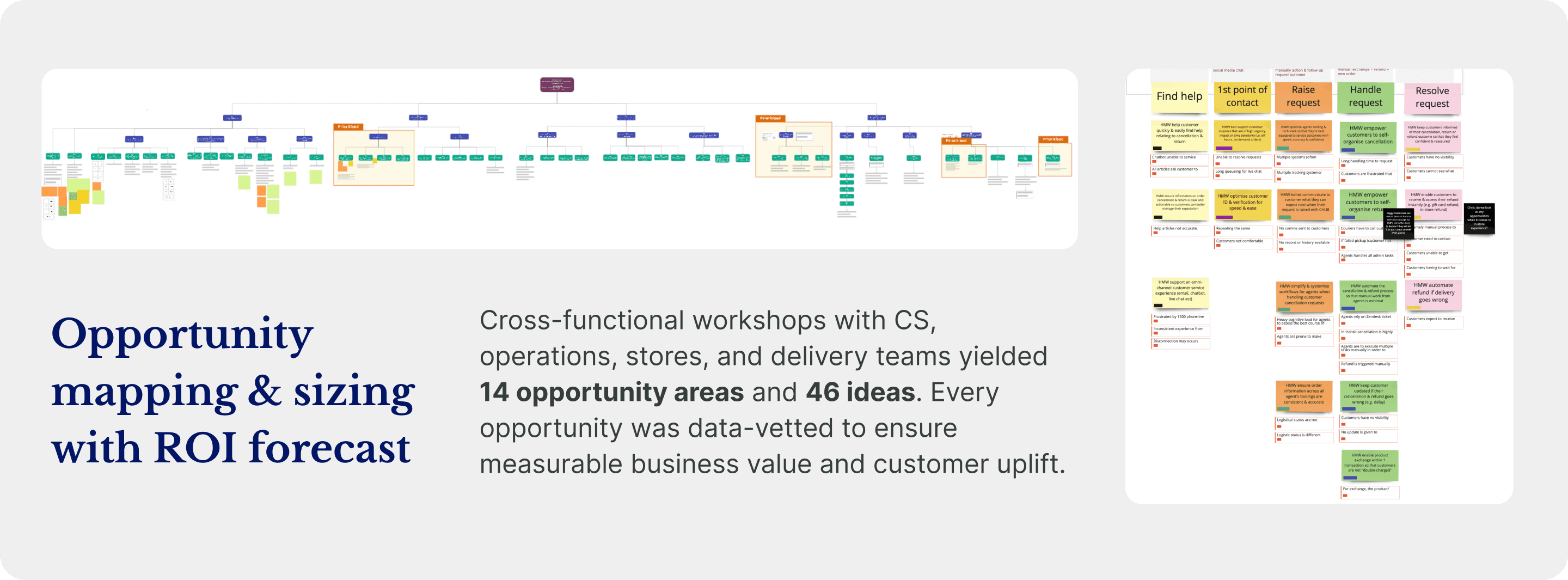
We ran workshops with stakeholders across customer service, operations, stores, and delivery. The output was deliberately broad: diverge first, then converge. Every idea was then assessed against customer value and business impact.
Rather than a flat priority list, we tiered the opportunities into three categories to force strategic clarity:
Big Rocks: high-impact and cross-functional, requiring aligned investment to unlock
Medium Stones: squad-level and focused, achievable in the near term
Small Pebbles: lower priority, or work better owned by other teams
Four big rocks, with a clear why
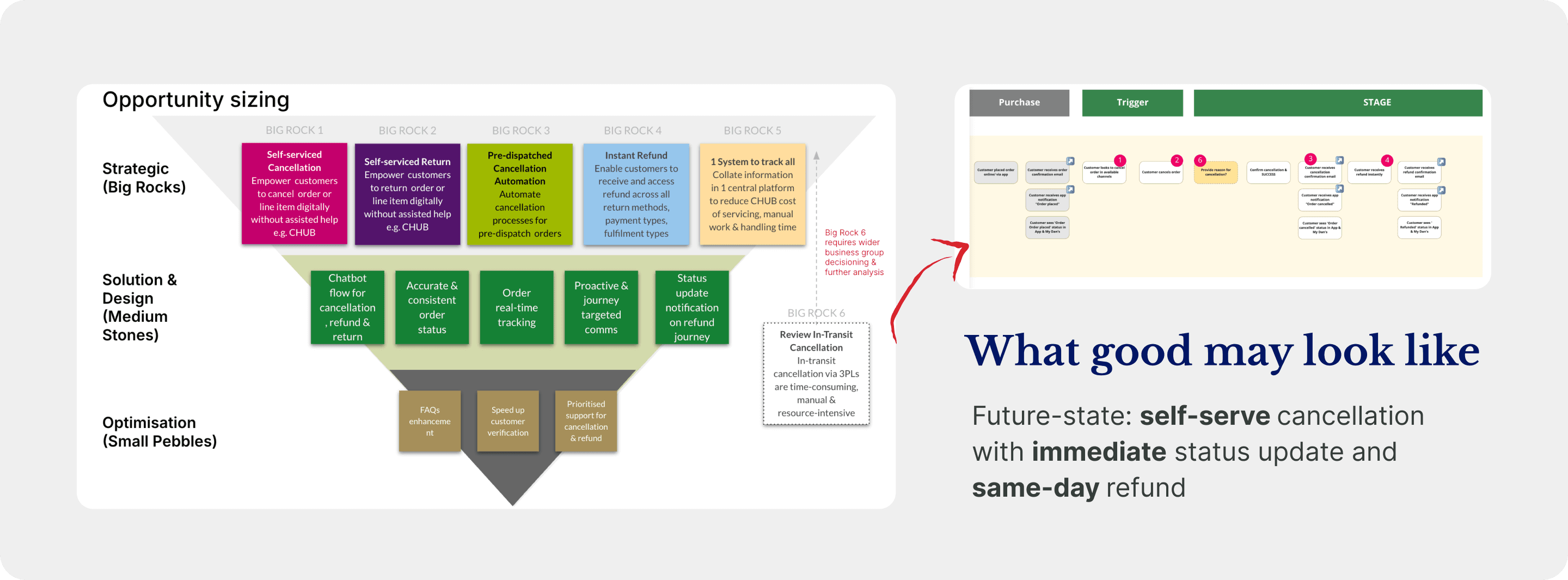
Self-serve cancellation
No digital cancellation existed. Average wait time to reach an agent: over 10 minutes, rising to 15+ at peak. For on-demand orders with a window as short as 10 seconds, customers were already too late by the time they got through. The cost was both operational and reputational.Pre-dispatch cancellation automation
42% of all cancellations. Simplest to resolve. Systems already in place. The highest-ROI, lowest-effort item on the roadmap, and also the most urgent, because every minute of queue time risked the order crossing into a far more complex in-transit scenario.Instant refund
Standard refunds took 3-5 business days. No status updates. No proactive comms. Customers contacted the team a second time just to confirm action had been taken, adding volume with zero value. The opportunity: reduce timelines where possible, and communicate proactively where they could not be reduced.Self-serve return
Three return methods existed. Only one was self-served. Australia Post drop-off and courier pickup both required customers to contact the team and wait for agents to arrange logistics on their behalf, adding unnecessary friction to an already frustrating experience.
The unlocked
Three artefacts were delivered:
11 service blueprints,
discovery Playback aligning the business on the as-is experience,
and an Opportunities Playback presenting the prioritised roadmap.
But the real outcome was a shift in how decisions got made. The work directly drove investment decisions across three separate product areas:
Pre-dispatch automation was fast-tracked as the first initiative.
Self-serve cancellation entered the chatbot and app roadmaps.
Refund communication improvements moved to the CRM team.
This project was fundamentally about making the invisible visible. It gave the business the evidence it needed to act with confidence, not instinct.